Explore Caesurae
Your destination for literary excellence, cultural commentary, and profound reflections from India and the world.
Join Our Newsletter
Stay updated with our latest articles and insights. We promise not to spam your inbox.
A Review by Gita Viswanath
The pandemic has set the creative juices flowing for artists and writers. We have seen a plethora of publications based on Covid in the last year in various genres. The virus and the consequent lockdown foregrounded situations that we had never faced before. The resultant changes in socio-cultural-economic spheres led to the revelation of aspects of human behaviour that caused great interest among creative persons. Long hours of silence, emptiness, and reflection on the one hand combined with a flurry of activity in the digital space on the other became an ideal breeding ground for thought and creative output.
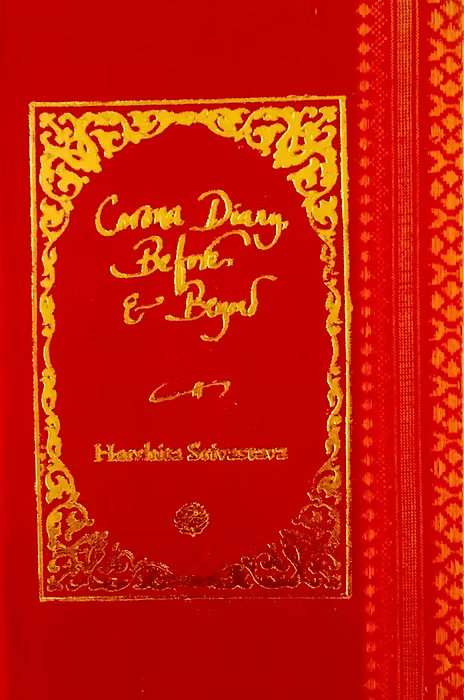
‘Corona Diary, Before & Beyond’ is a collection of poems by a young Masters student, Harshita Srivastava. The longest section of the book, titled ‘Corona Diary’ is sandwiched between sections termed as ‘Before’ and ‘Beyond.’ We may now safely attribute the initials BC to Before Corona and/or Beyond Corona!
The section titled ‘Before’ contains love poems addressed to the moon or the lover, poems on the theme of betrayal, and rain poems that lead to contemplation and resurfacing of memory. The opening poem of this section is a love poem disguised as an address to the moon. Rain is a trigger for memories or the lack of. The poems in this section have images that evoke life and joy, such as buzzing wasps, cooing cuckoos, warm coffee, stars, fireflies, etc. The use of alliteration in phrases such as breathes a blemish, files and folders, corners and crevices, fly or fall provide a musical quality to poems in this section. However, some poems also articulate betrayal in poignant ways with various moods of anger, sadness and reflectiveness. In ‘Before Another January,’ sharp anger is expressed in the following lines:
Tie those laces
And chase only those
Who appreciate
Your lone birthday wishes, (pg. 19)
The desire to record details in minutiae, as in the following lines:
Look! There’s that smile
Hiding in a corner of
18:56:43 – 12.09.07 (pg.12)
takes on a sinister role in the Corona Diary section, where every poem is titled by date in diary-writing style and the luxury of detailing that comes with silence and inanition of the lockdown gets stark.
During the lockdown, a lot of people reported observing things they wouldn’t have had in the hustle-bustle of daily lives. Several poems reflect such observation of the generally unobserved and ignored creatures or phenomena. For instance, ‘A line of ants’ (pg. 52) or ‘A fly buzzes, A beetle crawls, (pg.43). The pandemic also saw people becoming more attentive to nature. “A fluttering blue bird” (pg. 47) catches the poet’s eye. Poem 01.05.20 uses pathetic fallacy to demonstrate nature mimicking the sudden disorder of human lives. In one of my favourite poems 28.05.20, the poet watches a firefly as it appears and disappears. In an instance of personification, the dark air too is disturbed by the sights.
A lost firefly
Wanders
And disappears;
The dark air,
As if tired
Of all the visions
Illuminated
By its light. (pg. 59)
Predictably, the lockdown features as a major trope with images of emptiness, silence and loneliness. For instance,
All bubbles filled
With anecdotes and mirth
Have burst and vanished
Into empty rooms
With lonely benches staring
A half-erased blackboard. (pg. 57)
Clothes are personified when described as crying due to disuse in 13.05.20 (pg. 52). Constriction, monotony, and the insecurity of humans that were brought forth during the pandemic is encapsulated in the recurring image of the cage. Even if trite, the image evokes the isolation imposed on us. There’s an immediacy to this section on Corona. Poems spring from the present lived experiences and are thus highly relatable. The eeriness of burning bodies comes across in 09.05.20 (pg. 50). A sense of disarray, disharmony and derangement is conveyed in several poems.
Seasons, months, hours –
All out of harmony. (pg. 48)
At a time when death became commonplace in the form of newspaper and television reports and visuals, cries in the neighbourhoods or social media posts of loss of dear ones, poetry cannot help but deal with this thematic. Several poems in the Corona section engage with death, some with direct reportage tone, some with irony and some others with befuddlement. The accompanying trope of memory also features in several poems. 08.04.20 has an eerie tone.
Memories seem
To evaporate into
The smoke of numbness,
As this strange
Stretch of monotony
Slithers around the neck,” (pg. 34)
The last poem of the middle section 01.06.20 is reassuring of human resilience even if it sounds prosaic like a pledge.
Rise we shall
Up, up, up! (pg. 61)
West Bengal from where Srivastava hails witnessed the devastating cyclone Amphan in the midst of the virus and the lockdowns. As a consequence, Srivastava in her diary-entry-like poems alludes to this natural disaster that only exacerbated human misery.
Catastrophe speaks
In odd languages,
The ones spoken in screaming silence. (pg. 59)
The section ‘Beyond’ has just one poem called ‘Colours Frozen in Icicles.’ It speaks of a changed world, a world that has “dark overtones” that overwhelm streets where “rainbows crept up and down” (pg.64). The poem, once again, ending with a question, “Little by little, one at a time?” (pg. 65) dwells upon thoughts of how to deal with an unprecedented situation using satire as well as reflectiveness.
The poems in all sections of the collection pose a number of questions, especially in the last line. For instance, ‘Attempts’ ends with “Do you still feel stuck?” (pg. 14). The concluding line of 06.04.20 (pg.33) is “Is she now imprisoned?” Perhaps questions are indicative of the poet’s attempts to grapple with difficult and complex thoughts. The interrogative mood also acts as a poser to the readers forcing us to think.
The three sections in the collection seem to stand as autonomous parts with little conversation among them. The Corona section, much like the current situation in the world, comes across as an interruption, a disruption of a life that could have never anticipated such an eventuality. And now I end with a little bit of nit-picking: gobbling on (pg. 64) in an otherwise well-produced, engaging book of poems.
______________________________________________________________________________________________